

 Valves Overview
 Back to Conventional
| Ball
| Butterfly
| Diaphragm Valves
Back to Conventional
| Ball
| Butterfly
| Diaphragm Valves
Valves are classified by type, design variations and function. Valves can also be classified by material, end connections and pressure-temperature ratings.
The material classification generally refers to the valve body material such as bronze, iron, steel, stainless steel and plastic. The valve body may be produced with one material and the trim, may or may not be made of the same material.
Valve trim is exposed to flow media and may be made of a different material than the valve body. The trim is normally more corrosion resistant than the valve body, so that corrosion is less likely to occur at the valve seating area.
The earliest known types of valves were plug valves, which were first made of wood. During the industrial revolution, metallic gate and globe valves, along with plug valves, were widely used. It wasn’t until rubber compounding and plastic were developed that quarter-turn valves were widely used in our industry.
The valve is actually stated by the NPS of the valve end connection. You should know that NPS is the abbreviation for Nominal Pipe Size. It refers to the named size of the pipe. The NPS of the valve end connections must always match the NPS of the line in which it is to be installed.
The valve material and the line size will determine the type of end connection. The end connections refer to the ends of the valve body, which are connected to pipe ends. There are a number of different types of end connections available on today’s valves.
Each type of valve material has pressure and temperature limits. If the valve is exposed to pressures and temperatures exceeding the specified limits, the valve will not work properly.
When pressure or temperature limits have been exceeded there is danger of damaging or ruining the valve.
Valves are further described by specifications developed by certain governing groups. These groups have developed valve standards so that the valve supplied is able to perform its intended use.
The American Society for Testing and Materials (ASTM) establishes materials standards including the chemical and physical properties of all valve materials.
The American Society of Mechanical Engineers (ASME) develops standards for end connections, pipe threads and end-to-end dimensions.
ASME and the Manufacturers Standardization Society of the Valve and Fitting Industry (MSS), maintain standards on valve ratings and markings.
Other important valve specification groups include the Federal Government and various industry-related groups. The American Water Works Association (AWWA) is an industry-related group, which also establishes valve specifications. AWWA establishes standards for valves used in water supply systems.
Another key standards organization is the American Petroleum Institute (API). There are some API standards concerning the design and testing or various valve types for use in the petroleum industry.
You will also find NACE valves. NACE stands for National Association of Corrosion Engineers. NACE valves are used in the gas and oil production, which enables the valve to resist sulfide stress cracking that, might occur otherwise in high sulfur crudes.
The substance or medium flowing through a valve will often determine the type of valve material. Some valve materials are best suited for high temperature. Other materials are best suited for their corrosion resistance to fluid substances. In addition, some valve materials are selected when low cost is a factor.
Manufacturers will provide you with information to aid you in selecting the right valve for an application.
Bronze valves are commonly used for plumbing, heating and air-conditioning non-spec applications or for use in water supply systems. Bronze valves are generally selected when the line size is under 3” and low cost and availability are important. Bronze valves are made by pouring a copper alloy into sand molds.
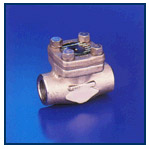 Valves
are also made of iron. Most iron valves are made of cast iron. The valve body material
may or may not be made of the same material for the valve trim.
Valves
are also made of iron. Most iron valves are made of cast iron. The valve body material
may or may not be made of the same material for the valve trim.
Valves are also made of ductile iron. Another name for ductile iron is nodular iron. Ductile iron is most often used in the marine industry and for underground pipeline. Ductile iron valves can be used in applications that experience vibration and shock. Ductile iron absorbs shock and also has good corrosion resistance.
While there are no size limitations for iron valves, these valves have temperature limits. Cast iron has a temperature limit of approximately 450 F. and ductile iron has a limit of 650 F.
Valves are also made of steel and stainless steel. Steel valves can be separated into two categories based on how the valve is made. Forged steel and or cast steel. Forged steel is formed from heated slugs, which are forged into the valve shape by huge forging hammers and presses. Cast steel is melted in a furnace and then poured into molds in a foundry.
Forged steel
valves are used when higher pressures and temperatures are involved
and the line size is generally under 2-1/2”. Other
factors could also favor the selection of forged steel, such
as system requirements for socket-weld piping and compatibility
of media. 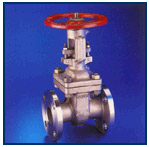
Cast steel valves are generally used on line size over 2” when higher pressures and temperatures demand the use of carbon or alloy steel.
Stainless steel valves are also frequently used for industrial applications. Stainless steel is used when corrosion is a problem. Gate, globe and check valves are three common types of corrosion-resistant valves. These corrosion-resistant valves are used in chemical process, petroleum refining, petrochemical, pulp and paper, and electric utilities industries.
The chemical industry and other industries use plastic valves. The most common types of thermoplastic used are: chlorinated polyvinyl chloride and polyvinyl chloride. You know these materials by their more common respective acronyms: CPVC and PVC.
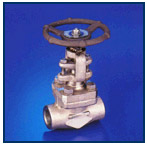 PVC
is the most common plastic used in manufacturing valves.
PVC is the most economical and can be used for more applications
than other plastics. However, PVC is limited to temperatures
of 140 F.
PVC
is the most common plastic used in manufacturing valves.
PVC is the most economical and can be used for more applications
than other plastics. However, PVC is limited to temperatures
of 140 F.
The CPVC valve is used in many PVC applications, which have high temperature requirements. The CPVC valve can service temperatures of 45 to 70 F higher than PVC valves.
The most common types of plastic shutoff valves used in the chemical industry are the ball and the butterfly valves. These valves may have threaded or solvent weld end connections.
Another plastic term you should know is TFE. TFE is the acronym abbreviation for Tetrafluoroethelyene. TFE is commonly used as a seal material in quarter-turn valves such as the ball or plug valve.
There are four major types of end connections:
threaded, solder or brazed, flanged and weld.
Threaded end connections are tapped with ANSI standard female taper pipe threads. Usually, threaded ends are used on valves 3” or under.
Solder or brazed ends are also used on bronze valves under 3”. Some piping systems, particularly hot and cold water, are more cost effective with copper tubing fittings and valves, which are assembled with, solder joints. However, the heat applied may possibly damage the valve seats if not properly controlled.
Flanged valves. This type of connection is generally used on line sizes over 2”. Flanged end connections must be connected in a special order to maintain a tight seal and prevent flange distortion. This procedure places uniform stress at each end connection. Thus eliminating a leaky gasket. Always check your manufacturer’s literature to find the correct method suggested by the individual manufacturer. Flanged valves are easier to replace in an existing installation than most other types of end connections. When valve replacement is necessary, the flange fasteners are taken out. The valve can then be easily replaced.
Compare wafer butterfly and flanged gate valves. If both
types of valves are equally suited, a butterfly valve may make
a better selection. From an installation standpoint, a
gate valve is more difficult to handle, requires more time to
install and costs more. The gate valve requires two gaskets
and two sets of fasteners, one for each flange end.
The butterfly valve requires no gaskets since the sleeve provides
the tight seal. And, only one set of fasteners is needed
because the face-to-face dimensions are much shorter than the
end-to-end dimensions on the gate valve.
Gate valves weigh more and have longer end-to-end dimensions
than comparable butterfly valves.
Both valves described provide the on/off function. Remember, too, that the proper materials must be selected for the specific application, and the pressure-temperature ratings must be observed for either valve.
There are two major facings found on flanged valves. Facing refers to the type of face that is machined on the flanged end.
Flat face flange end. When bolted together, this type of end connection will match flush, face-to-face.
Raised face flange end. The face of the flange end is slightly raised to protrude from the end.
There are variations of the facings used on flanges. They may be but not limited to the following. Male and female facing. Small male and female facing. Tongue and groove. Ring joint or ring type connection.
Weld connections are generally used on high pressure and high temperature applications. You should know that only certain materials are weldable, such as carbon steel, alloy steel and stainless. Remember that the valve material will often govern the type of end connection. Weld connections are used when a tight, leak proof seal must be provided over a long period of time. You will find two types of weld connections, butt weld and socket weld.
Socket weld connections utilize deep sockets at each end of the valve. To make the connection, pipe is inserted into each valve socket and then seal-welded to valve.
Butt weld connections are used on larger valves and piping. Socket weld connections are recommended for smaller size valves and piping.
In addition to the valve material and end connections, it is important to know the valve temperature and pressure limits.
Pressure is the force applied to the interior valve parts. When we talk about valve pressure limits we are talking about the maximum pressure the flow media can exert across the valve. When a liquid flows through a piping system, the flow is resisted by friction of fluid particles rubbing against one another and the surface of the pipe. This resistance results in a loss of energy, which is call pressure drop.
Factors affecting pressure drop are the roughness of the pipe, pipe diameter, flow velocity, density and viscosity of the flow media.
Different valve materials have different pressure ratings. Some materials can hold more pressure than other materials. And, other materials are better suited for different temperatures.
The stronger a material is, the more pressure can be applied to it. Pressure is often measured in pounds per square inch known as psi.
While a ball valve may be made of stainless steel to resist corrosion, the valve may be limited in applications due to the packing, gasket or other trim material.
Today “class” describes the pressure and temperature rating systems of valves. MSS publishes these class ratings as recommended or standard practice for the industrial valves.
Historically, the valve industry classified valves by saturated steam ratings and a secondary rating called “WOG”. WOG stand for water, oil or gas. “OWG” which is a rearrangement of WOG was also used.
Under that rating system, a 125 lb. Bronze valve had a saturated steam rating of 125 psi and carried a secondary rating of 200 psi for oil, water or gas at cold temperatures (-20 F to 150 F).
PIPE
ASTM A312 / ASME SA312
ASTM A358 / ASME SA358
ASTM A376 / ASME SA376
ASTM A778
TUBE
ASTM A213 / ASME SA213
ASTM A249 / ASME SA249
ASTM A269
ASTM A511
ASTM A554
FLANGES
ANSI Flanges
Plate Flanges
Insert Flanges
Ductile Iron & Carbon Steel Flanges
AFR Rings & C/S Backup Flanges
FITTINGS
Butt Weld Fittings
150 lb. Fittings
Pressure Fittings
Compression Fittings
Ultra High Purity Fittings
Vac & Non UHP Fittings
SANITARY
Fittings
Tubes
Valves
Diaphragm Valves
Centrifugal Pumps
Filters & Strainers
OUTLETS
View our
Outlets
PIPE NIPPLES
Intro & Specs
FLANGE PACS
Screws,
Insulation, Nuts,
Washers, Gaskets, etc.
TECH INFO
Piping Definitions
Tube
Stainless Steel
Alloys
Specifications
Conversion
Calculators
ORDER INFO
How to Order
CO. INFO
About RJ
Linecard (PDF)
 People Dedicated to Quality
800-666-0088 • Buffalo, NY (HQ)
800-777-0820 • Ann Arbor, MI
800-777-1355 • Ceres, CA
800-777-2008 • Chicago, IL
800-777-0820 • Cleveland, OH
800-777-1858 • Cranbury, NJ
800-777-2008 • Greenville, WI
800-777-0510 • Indianapolis, IN
800-565-5525 • Lakeland, FL
800-725-1839 • Los Angeles, CA
877-886-9010 • Phoenix, AZ
800-565-5525 • Raleigh/Durham, NC
800-777-2260 • Salt Lake City, UT
800-777-0510 • Springfield, MO
800-666-0088 • Tavenier, FL

The contents of this website are presented for information purposes only, and while effort has been made to ensure their accuracy, they are not to be contrived as warranties or guarantees, expressed or implied, regarding the products or services described herein or their use or applicability. All sales are governed by our terms and conditions, which are available on request. We reserve the right to modify or improve the designs or specifications of our products at any time without notice. Always verify that you have the most recent product specifications or other documentation prior to the installation of these products.
©2026 Robert-James Sales, Inc.
Site: ERGB