

 Jacket Insert Flanges Tech Data
 Jacket Insert Flanges [ Tech Data ]
 Standard Insert Flanges [ Tech Data ]
JACKETED INSERT FLANGES TECHNICAL DATA
1.3 Code References. Any references to the “Code” are limited to the ASME Boiler and Pressure Vessel Code, and not other state or governmental codes which may have jurisdiction.
1.4 Established Criterion. Insert flanges for jacketed piping have been used extensively by the processing industries for more than forty years. During these years, insert flanges have established a standard for dependable service by meeting the demands of critical jacketed piping systems.
1.5
Insert Flanges Per ASME B31.3. ASME B31.3,
Process Piping, provides requirements for the design of flanges
which are not listed as standards in Table 326.1, of the specification.
These requirements are found in paragraph 304.5.1. This states
that flanges may be designed in accordance with the Boiler Pressure
Vessel Code, Section VIII, Division 1, Appendix 2 or Appendix
Y, depending on whether the gasket OD is inside or outside the
bolt circle. It also states that flanges may be qualified by the
requirements of paragraph 304.7.2. This paragraph applies when
Appendix 2 or Appendix Y are not applicable and states that the
design is to be based on calculations consistent with the design
criteria on B31.3 and substantiated by one or more of the following:
a) extensive & successful service experience
under comparable conditions with similarly proportioned components.
b) experimental stress analysis similar to that described in BPV
Code, Section VIII, Division 2 Appendix 6.
c) proof testing in accordance with ASME B16.9, MSS SP-97, or
BPV Code Section VIII, Division 1, UG-101.
d) detailed stress analysis such as finite element. Since these
insert flanges are very similar to ASME B16.5 flanges, containing
the same ring-type elements, they can be reliably designed to
Appendix 2 of the BPV Code, Section VIII, Division 1.
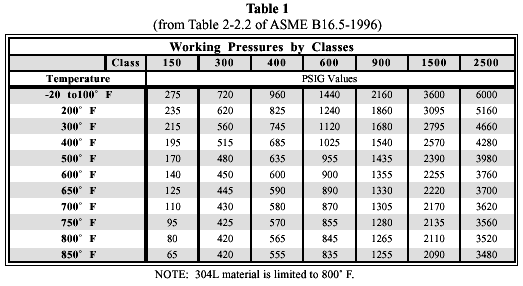
1.6 ASME Rated. When we refer to an Insert Flange as ASME rated
we are stating that calculations conforming to the ASME Boiler
and Pressure Vessel Code, Section VIII, Division 1, have been
performed which determine minimum flange thickness to meet ASME
B16.5 PSIG at material group 2.2 (see table 1).
These calculations are based on the use of carbon steel to SA-515/516
Gr70 or SA-105 material for the bolting ring and stainless steel
type 304, 304L, 316, 316L to SA-479 or SA-182 for the insert.
The bolting is to SA-193-B7 and the gasket material is spiral
wound. Any changes to the material, bolting, or gasket could change
the required dimensions of the insert flange, if meeting the P/T
rating of B16.5 is desired.
2.2 Non-Reducing
Jacket Insert Flange.
This phrase refers to the style or design of insert flange in
which the nominal core pipe size is equal to the nominal flange
size. Non-reducing jacket insert flanges require smaller flanges.
Along with the use of smaller valves and other fittings, considerable
cost and space savings in fabricating jacketed systems can be
realized.
2.2.1 Conventional Non-Reducing Jacket Insert
Flanges. These non-reducing jacket insert flanges have been used
successfully for decades. This style of insert flange is only
available in class 150 and 300. They utilize the economical advantage
of the ASME B16.5 flange thickness for their design but are not
recommended for critical applications which must meet code.
2.2.2 ASME
Rated Non-Reducing Jacket Insert
Flanges. This style of insert flange is available in all classes.
On this style of insert flange calculations conforming to the
ASME Boiler and Pressure Vessel Code, Section VIII, Division 1,
have been performed which determine minimum flange thickness to
meet ASME B16.5 PSIG values at material group 2.2 (see table 1).
Therefore, this style of insert flange can be used for ASME Code
and Pressure Vessel Applications.
3.2 Nominal Size. References to the size of a flange, pipe, or bolt is its nominal size. Use of "nominal" indicates that the stated size or dimension is only for designation, not measurement.
3.3 Sizes and Classes Not Cataloged. The sizes and classes are listed due to their frequency of request and are not meant as a capacity range. Insert Flanges can be manufactured in all ASME B16.5 classes and sizes.
6.2 Raised Face Dimensions. Inserts are manufactured with a raised face thickness equal to the corresponding ASME B16.5 dimension. The diameter of the raised face on the inserts are equal to, or greater than, the corresponding ASME B16.5 dimension. Larger raised face diameters are found on a few of the non-reducing jacket flanges. This is necessary when a jacket pipe’s inside diameter is greater than the standard ASME B16.5 raised face dimension. However, in all cases there is adequate bolting clearance.
6.3 Flange Facing Finish. Standard facing finish for the gasket surface of the insert is a continuous spiral or phonographic finish to an average roughness in the range of Ra 125 to 250 µin. This is the facing finish that will be supplied unless otherwise specified. Other surface finishes for flange faces can be ordered. These included, but are not limited to, specified smooth or unpolished finishes (e.g. Ra 32, 63, 125, 250, or 500 µin.), or a concentric serrated surface.

 9.1.1
Slip-on Insert Design. Measure, cut, and prepare process and jacket
pipe. With bolting ring/flange and insert assembled, slip process
pipe into insert and front weld end of process pipe at point A.
If required, back weld process pipe and insert at point B. The
assembly will require clam-shelling (see 9.3) a section of the
jacket pipe if the process pipe is back welded.
9.1.1
Slip-on Insert Design. Measure, cut, and prepare process and jacket
pipe. With bolting ring/flange and insert assembled, slip process
pipe into insert and front weld end of process pipe at point A.
If required, back weld process pipe and insert at point B. The
assembly will require clam-shelling (see 9.3) a section of the
jacket pipe if the process pipe is back welded.
9.1.2 Butt-Weld Insert Design. Measure, cut, and prepare process
and jacket pipe. With bolting ring/flange and insert assembled,
align process pipe to welding end of insert and weld. The assembly
will require clam-shelling (see 9.3) a section of the jacket pipe
when buttwelding the process pipe.
9.1.3 Transit Hub. As an alternative to clam-shell construction, we offer an optional transit hub for the jacket pipe. A transit hub allows the jacket pipe to slide further along the hub, thus allowing access to the welding area of the process pipe at the other end of the spool. If this is the preferred method of fabrication, specify this requirement when ordering. There may be an additional charge for modification. See picture to the right.
9.2 Weld Jacket Pipe. Slip jacket pipe over insert hub and weld at point C. When space allows, you may pull the bolting ring/flange back over jacket pipe to facilitate welding.
9.3 Clam-Shell. After welding process pipe to insert at point B, put clam shell section of jacket pipe into position and weld together. See Clam Shell drawing.
9.4 Align and Bolt. Rotate the bolting ring/flange to align it with its mating flange and bolt them together.
PIPE
ASTM A312 / ASME SA312
ASTM A358 / ASME SA358
ASTM A376 / ASME SA376
ASTM A778
TUBE
ASTM A213 / ASME SA213
ASTM A249 / ASME SA249
ASTM A269
ASTM A511
ASTM A554
FLANGES
ANSI Flanges
Plate Flanges
Insert Flanges
Ductile Iron & Carbon Steel Flanges
AFR Rings & C/S Backup Flanges
FITTINGS
Butt Weld Fittings
150 lb. Fittings
Pressure Fittings
Compression Fittings
Ultra High Purity Fittings
Vac & Non UHP Fittings
SANITARY
Fittings
Tubes
Valves
Diaphragm Valves
Centrifugal Pumps
Filters & Strainers
OUTLETS
View our
Outlets
PIPE NIPPLES
Intro & Specs
FLANGE PACS
Screws,
Insulation, Nuts,
Washers, Gaskets, etc.
TECH INFO
Piping Definitions
Tube
Stainless Steel
Alloys
Specifications
Conversion
Calculators
ORDER INFO
How to Order
CO. INFO
About RJ
Linecard (PDF)
 People Dedicated to Quality
800-666-0088 • Buffalo, NY (HQ)
800-777-0820 • Ann Arbor, MI
800-777-2008 • Chicago, IL
800-777-0820 • Cleveland, OH
800-777-1858 • Cranbury, NJ
800-777-2008 • Greenville, WI
800-777-0510 • Indianapolis, IN
800-725-1839 • Los Angeles, CA
800-565-5525 • Raleigh/Durham, NC
800-777-2260 • Salt Lake City, UT
800-777-0510 • Springfield, MO
800-777-1355 • Stockton, CA
800-666-0088 • Tavenier, FL

The contents of this website are presented for information purposes only, and while effort has been made to ensure their accuracy, they are not to be contrived as warranties or guarantees, expressed or implied, regarding the products or services described herein or their use or applicability. All sales are governed by our terms and conditions, which are available on request. We reserve the right to modify or improve the designs or specifications of our products at any time without notice. Always verify that you have the most recent product specifications or other documentation prior to the installation of these products.
©2024 Robert-James Sales, Inc.
Site: ERGB